Wednesday, December 21, 2022

What to Expect from the Housing Market in 2023


Keeping Matters Current

The 2022 housing market has been defined by two key things: inflation and rapidly rising mortgage rates. And in many ways, it’s put the market into a reset position.

As the Federal Reserve (the Fed) made moves this year to try to lower inflation, mortgage rates more than doubled – something that’s never happened before in a calendar year. This had a cascading impact on buyer activity, the balance between supply and demand, and ultimately home prices. And as all those things changed, some buyers and sellers put their plans on hold and decided to wait until the market felt a bit more predictable.

But what does that mean for next year? What everyone really wants is more stability in the market in 2023. For that to happen we’ll need to see the Fed bring inflation down even more and keep it there. Here’s what housing market experts say we can expect next year.

What’s Ahead for Mortgage Rates in 2023?

Moving forward, experts agree it’s still going to be all about inflation. If inflation is high, mortgage rates will be as well. But if inflation continues to fall, mortgage rates will likely respond. While there may be early signs inflation is easing as we round out this year, we’re not out of the woods just yet. Inflation is still something to watch in 2023.

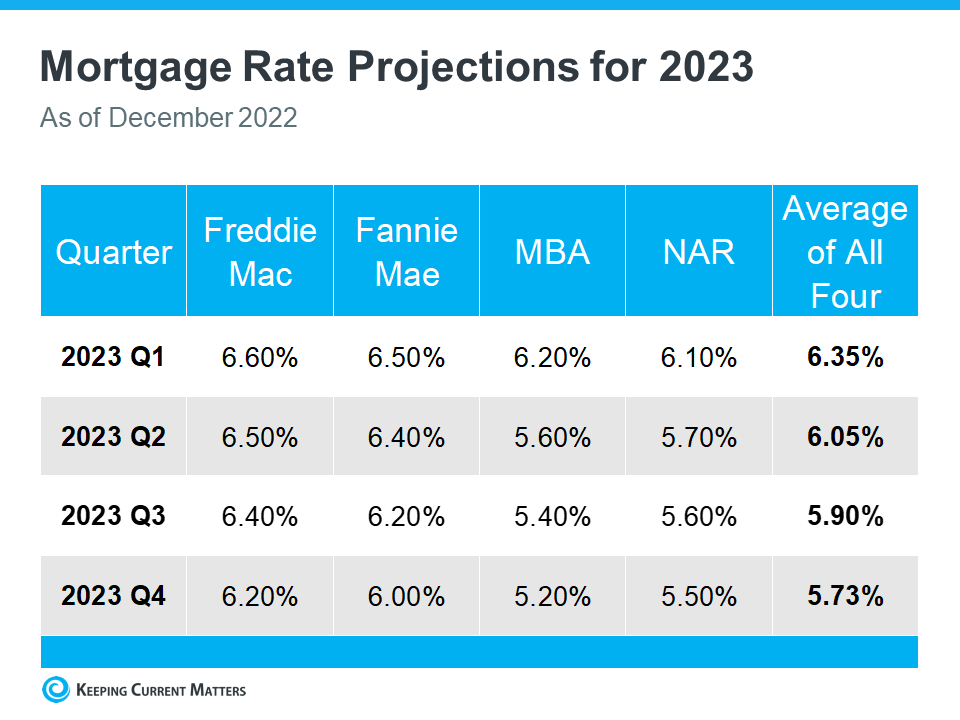
Right now, experts are factoring all of this into their mortgage rate forecasts for next year. And if we average those forecasts together, experts say we can expect rates to stabilize a bit more in 2023. Whether that’s between 5.5% and 6.5%, it’s hard for experts to say exactly where they’ll land. But based on the average of their projections, a more predictable rate is likely ahead (see chart below):

That means, we’ll start the year out about where we are right now. But we could see rates tick down if inflation continues to drop. As Greg McBride, Chief Financial Analyst at Bankrate, explains:

“. . . mortgage rates could pull back meaningfully next year if inflation pressures ease.”

In the meantime, expect some volatility as rates will likely fluctuate in the weeks ahead. If we see inflation come back under control, that would be good news for the housing market.

What Will Happen to Home Prices Next Year?

Homes prices will always be defined by supply and demand. The more buyers and fewer homes there are on the market, the more home prices will rise. And that’s exactly what we saw during the pandemic.

But this year, things changed. We’ve seen home prices moderate and housing supply grow as buyer demand pulled back due to higher mortgage rates. The level of moderation has varied by local area – with the biggest changes happening in overheated markets. But do experts think that will continue?

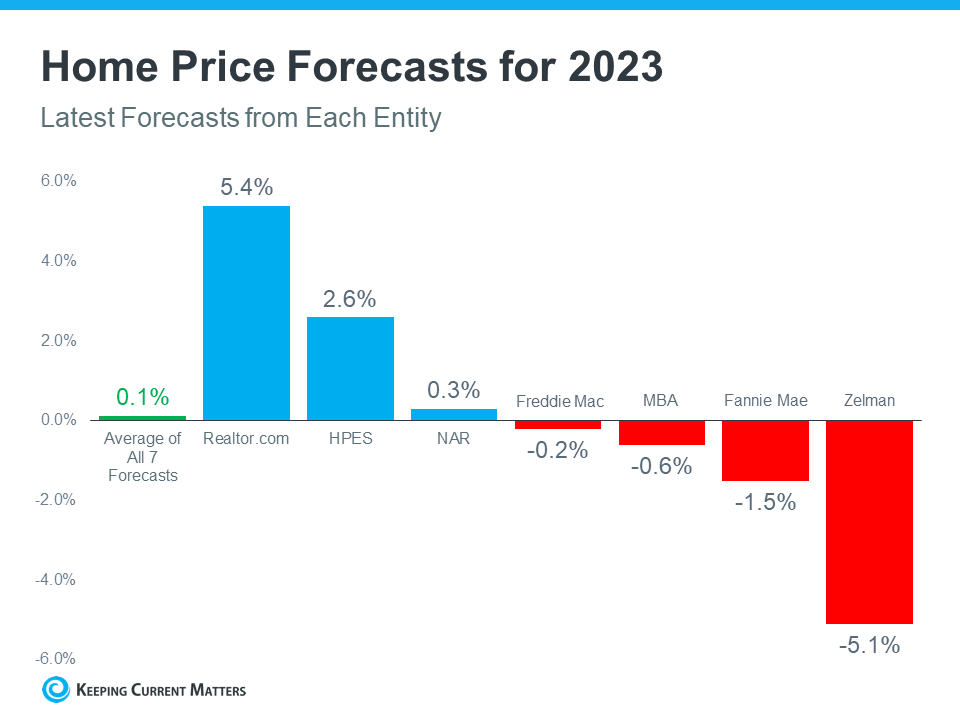
The graph below shows the latest home price forecasts for 2023. As the different colored bars indicate, some experts are saying home prices will appreciate next year, and others are saying home prices will come down. But again, if we take the average of all the forecasts (shown in green), we can get a feel for what 2023 may hold.

The truth is probably somewhere in the middle. That means nationally, we’ll likely see relatively flat or neutral appreciation in 2023. As Lawrence Yun, Chief Economist at the National Association of Realtors (NAR), says:

“After a big boom over the past two years, there will essentially be no change nationally . . . Half of the country may experience small price gains, while the other half may see slight price declines.”

Bottom Line

The 2023 housing market is going to be defined by mortgage rates, and rates will be determined by what happens with inflation. The best way to keep a pulse on what experts are projecting for next year is to lean on a trusted real estate advisor.

Labels: , , , ,

Thursday, January 13, 2022

Dr. Lawrence Yun's Outlook for 2022 Real Estate Market


By Jordan Grice                          Rismedia


2022 Housing Market Faces Changes Amid Economic and Regulatory Activity

January 13, 2022


With real estate professionals gearing up for another strong year, two of the industry’s leading experts dove into the most significant economic and regulatory issues on the horizon and their implications for the real estate market, during RISMedia’s Real Estate’s Rocking in the New Year on Jan. 6.

Last year saw record-level activity on home prices and mortgage rates. Still, it also left several challenges facing the housing market this year.

During the virtual session “The Economy: Where Do We Stand Now…And What Lies Ahead?,”  Dr. Lawrence Yun, chief economist for the National Association of REALTORS®, laid out his predictions for the housing market as the economic recovery continues amid the pandemic.

“The economy is expanding,” Yun said. “Every passing month we are generating new jobs.”

While Yun indicated that recent job growth has been lighter than previous months, he said conditions in the labor market are improving monthly, which is a good sign for the broader economy.

“Nonetheless, the job improvement is implying one thing for the housing market: the rental demand has certainly picked up significantly,” said Yun, adding that there has been a 5% uptick in rents as a result.

Rising rents, coupled with elevated inflation, will likely motivate more people to enter the home buying market in the future as a hedge against inflation, according to Yun.

“In a rising inflationary period, particularly where it really hurts rising rents, it will motivate some of the financially well-qualified renters to consider buying a home,” said Yun. “That is why I believe that the spring homebuying season will be very robust.”

Last year saw intense competition for a razor-thin supply of homes, which ultimately drove home prices sky high and squeezed buyers out of the market. Despite Yun predicting strong activity in the spring, he suggested this year might not be as intense as 2021.

He cited rising mortgage rates as one crucial contributor.

“We don’t know precisely when, but when the mortgage rates rise, it will make a sudden jump, maybe a 50-basis-point jump—so mortgage rates going from 3% to 3.5% in one or two week’s time span and then staying at that level,” Yun said.

Yun then pivoted his report to address concerns over inventory constraints, stating that supply chain bottlenecks that strained builders last year will possibly start to dissipate in the spring.

Another source of inventory likely to take hold are homeowners that participated in pandemic-induced mortgage forbearance programs that are winding down, Yun said.

“That program is ending, which means that homeowners in that situation have two options: find a job and start making payments or list the property for sale,” Yun said, and went on to suggest that a portion of homeowners will opt for the latter, which will add to the pool of new homes for sale.

“Overall, Spring homebuying season should be very robust,” Yun said. “Maybe not matching up with last year’s intense multiple offers, but one of the best in the past 20 years.”

On the regulatory and legislative front, 2022 promises lots of activity that real estate professionals will want to pay attention to, according to Ken Trepeta, executive director of the Real Estate Services Providers Council.

Trepeta hosted the “Inside the Beltway: What’s Happening in Washington and What Matters to Real Estate” virtual session, where he dove into the activity to come out of the Biden Administration this year.

“2022 is going to be a very interesting year with a lot of wildcards, and it’s going to be a heated political year,” Trepeta said. “It seems like it’s full steam ahead for all of us in terms of the housing market so far, but there is a lot that can happen, and there is a lot to watch out for.”

Trepeta indicated that policymakers would be prioritizing social justice and equity for minority communities in the housing, finance, and mortgage industries.

“I think we’re going to see activity out of the Consumer Financial Protection Bureau and the Department of Housing and Urban Development,” Trepeta said, he added that there will be a greater focus on fair housing, fair lending geared toward dealing with disparities in homeownership.

As a result, he encouraged the virtual event attendees to take a more proactive approach in their outreach plans and policies to account for minority groups and communities.

Trepeta also said that the industry should keep an eye on increasing emphasis on the environmental front pertaining to housing construction.

“There is this idea that there’s something wrong with single-family housing—that it’s somehow environmentally wasteful—that has caught on with a lot of folks in the bureaucracy,” Trepeta said.

He also indicated that some are pushing for more rental housing than single-family construction as a result.

“Anything that discourages new construction of single-family homes, in particular, is going to have an impact on inventory and prices,” Trepeta said.

Another metric that has captured headlines in recent months has been inflation, which has remained elevated since 2021.

How the Federal Reserve decides to address inflation in the foreseeable future leaves many questions, according to Trepeta, who pointed to recent announcements that interest rate hikes are on the horizon in 2022.

“Will it be under control and how soon will that be?” Trepeta asked. “I think that will definitely affect folks.”

Labels: , , ,